
Claude-Mem: The End of "Amnesia" in Artificial Intelligence
Claude-Mem: The End of "Amnesia" in Artificial Intelligence
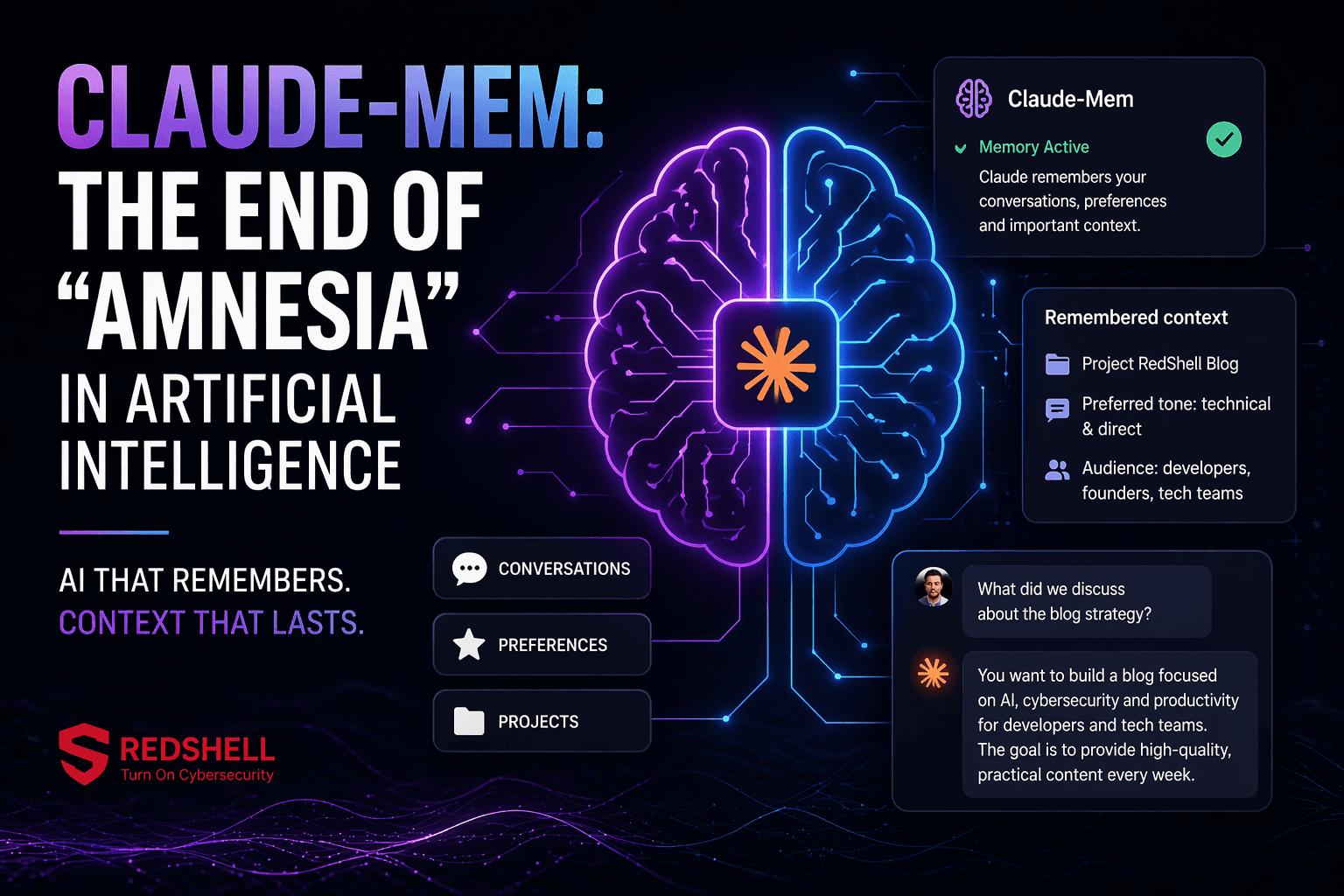
Claude-Mem: The End of "Amnesia" in Artificial Intelligence
If you use AI to code or structure complex projects, you know this pain: you close the window, go to sleep, and the next day your assistant has "amnesia." You have to re-explain the architecture, the bugs you fixed yesterday, and your core design decisions.
That endless loop of copying, pasting, and re-contextualizing just broke. The tech community is obsessing over a new tool that is changing the rules: Claude-Mem.
What exactly is it, and why should you try it today? Let’s break it down.
⚡ The Real Problem: The "New Employee" Syndrome
Until now, using coding agents like Claude Code came with a frustrating limitation: they are brilliant within a single session, but the moment you open a new one, they forget everything.
- ❌ Before: Wasting 20% of your time (and hundreds of tokens) writing a giant prompt to summarize what you did over the last 3 days.
- ✅ Now (with Claude-Mem): A silent observer that takes real-time notes on every decision, bugfix, and refactor, saving it securely on your local machine.
3 Superpowers of Claude-Mem (Why it stands out)
This isn't just a simple notepad. It uses a biomimetic memory architecture (designed to mimic how human memory works). Here is what it does brilliantly:
1. Automatic & Silent Capture
You don't have to say "remember this." Claude-Mem installs as a plugin and watches the tools Claude uses. If the agent fixes an issue in your payment gateway, Claude-Mem automatically tags that action (e.g., 🔴bugfix23) and saves the "before and after" context.
2. Goodbye RAG, Hello RAD (Real-Time Agent Data)
While traditional RAG (Retrieval-Augmented Generation) fetches static external documents, Claude-Mem introduces RAD: standardizing how an agent captures its own working memory. It understands your project's history exactly the way you do.
3. "Progressive Disclosure" (Radical Token Savings)
You would think injecting memory into every session would burn through all your tokens. False. Claude-Mem uses "progressive disclosure": at the start of a session, it only injects a super-lightweight index (just titles and tags). The AI only dives deep and spends tokens if it actually needs to fetch the granular details of a past event.
Who is this for?
This isn't a tool for drafting emails. It's heavy artillery if you are:
- 👨💻 Developer or Tech Lead: Working on massive repositories where long-term context is vital.
- 🎯 QA / Debugger: Needing to track down why an architectural decision was made 3 weeks ago without reading endless logs.
- 🎨 Product Creator: Iterating in discontinuous phases (coding a bit on the weekend and picking the project back up a month later).
Redshell's Take
What Claude-Mem does isn't just a quality-of-life improvement; it's an evolutionary leap in how we interact with autonomous agents. Moving from ephemeral memory to persistent cross-session memory means the AI finally starts accumulating seniority in your specific project.
If the AI stops wasting time remembering, you can start scaling faster.
How to try it right now
It runs locally and is 100% Open Source.
Don't use it like this: ❌ Expecting the "magic AI" to remember everything without giving it the right tools.
Use it like this: ✅ Install it in your terminal by running: /plugin marketplace add thedotmack/claude-mem and tell Claude in your next session: "Pick up exactly where we left off with yesterday's bug."
👉 Explore the documentation and try it at claude-mem.ai
Conclusion
Agent-assisted development is already the standard. Development with agents that have persistent memory is the immediate future. Are you going to be left behind?
👉 If you like these raw, straight-to-the-point tech discoveries, subscribe to Redshell and level up your workflow.