
From Turing to ChatGPT: The 70-Year Race That Built Modern AI
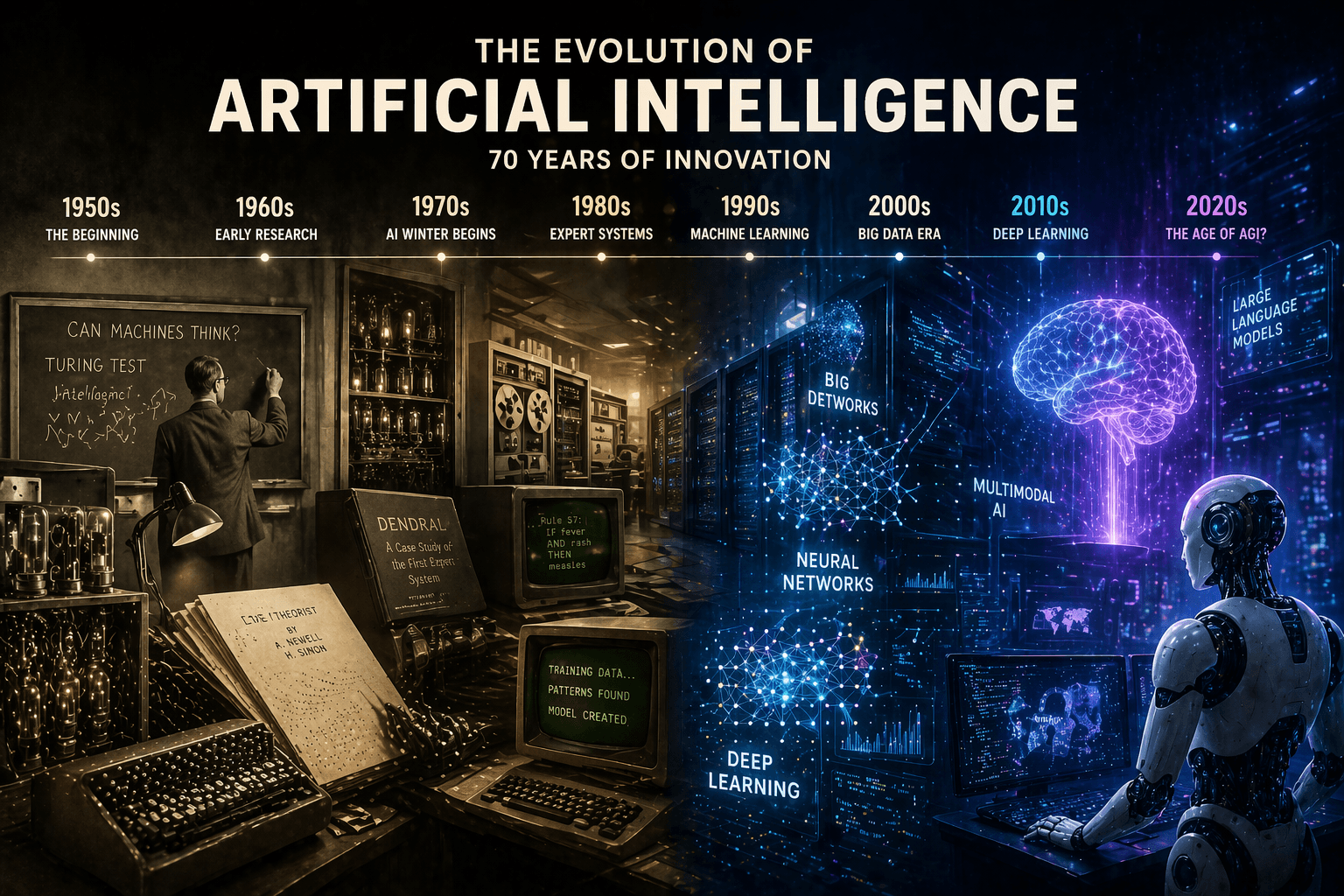
Artificial intelligence didn't appear overnight. It took seven decades of breakthroughs, funding crashes, and a few stubborn believers to get from a thought experiment to a technology reshaping every industry on Earth.
From Turing to ChatGPT: The 70-Year Race That Built Modern AI
Meta: Artificial intelligence didn't appear overnight. It took seven decades of breakthroughs, funding crashes, and a few stubborn believers to get from a thought experiment to a technology reshaping every industry on Earth.
AI & Machine Learning · 4 min read
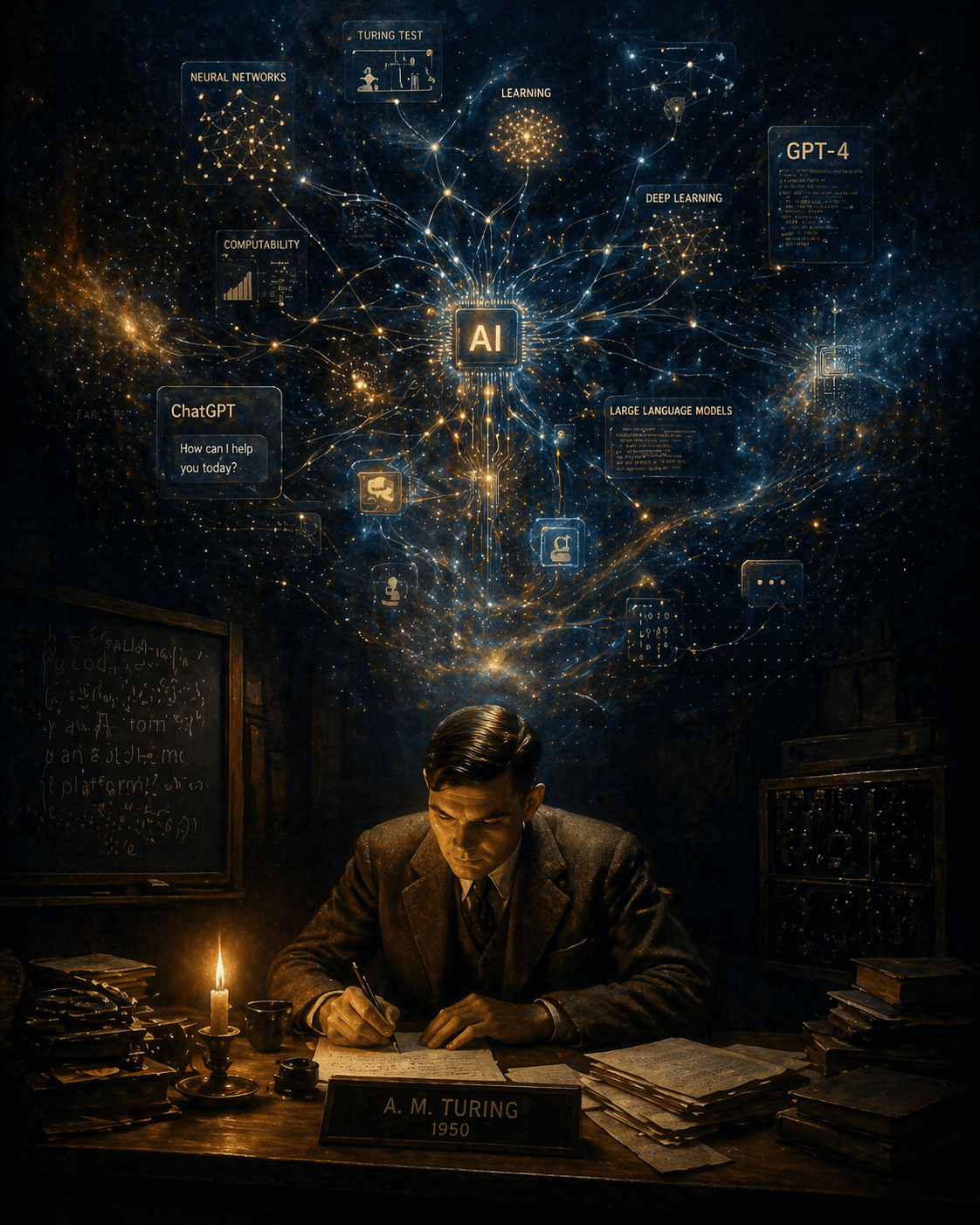
Most people think AI started with ChatGPT. It didn't. The ideas that power today's large language models were planted in 1950, when a British mathematician asked a question so simple it sounds almost naive: Can machines think?
That question — posed by Alan Turing in a paper that introduced what we now call the Turing Test — launched one of the longest and most turbulent technological pursuits in history. Here's how it unfolded.
The Birth of an Idea (1950–1969)
In 1956, a group of researchers gathered at Dartmouth College for a summer workshop. John McCarthy, Marvin Minsky, Claude Shannon, and others agreed on a bold premise: every aspect of human intelligence could, in principle, be described precisely enough for a machine to simulate it. McCarthy coined the term "artificial intelligence" at that meeting.
Early optimism ran high. Researchers built programs that could solve algebra problems, play checkers, and hold simple conversations. ELIZA, a chatbot created at MIT in 1966, fooled some users into thinking they were talking to a human therapist — a party trick that raised serious questions about what "understanding" really means.
The AI Winters: When the Hype Died (1970s–1990s)
Progress stalled. Twice.
Computers lacked the processing power to handle complex tasks. Funding agencies grew impatient with researchers who promised too much and delivered too little. The U.S. and U.K. governments slashed AI budgets in the mid-1970s, triggering what historians now call the First AI Winter. A second followed in the late 1980s after expert systems — programs built on hard-coded rules — proved too brittle for the real world.
These weren't failures of imagination. They were failures of infrastructure. The hardware simply wasn't there yet.
The Deep Learning Revolution (2000s–2012)
The modern era of AI has a precise starting point: 2012.
That year, a neural network called AlexNet, built by Geoffrey Hinton's team at the University of Toronto, won the ImageNet visual recognition competition by a margin that stunned the field. It didn't just win — it obliterated the competition, cutting the error rate nearly in half compared to traditional methods.
The key ingredient was deep learning: neural networks with many layers, trained on large datasets using GPUs originally designed for video games. Suddenly, the hardware and the data were available. Everything changed.
Within three years, Google, Facebook, and Baidu had built dedicated AI research labs. By 2016, DeepMind's AlphaGo defeated the world champion at Go — a game with more possible positions than atoms in the observable universe — something experts had predicted was still decades away.
The Large Language Model Era (2017–Present)
In 2017, researchers at Google published a paper titled "Attention Is All You Need." It introduced the Transformer architecture, the foundation of every major AI language model in use today — including GPT-4, Gemini, and Claude.
OpenAI released ChatGPT in November 2022. Within five days, it had one million users. Within two months, 100 million. No consumer application had ever grown that fast.
Since then, AI has moved from research labs into spreadsheets, medical diagnostics, legal documents, chip design, and drug discovery. The technology that took 70 years to mature is now compressing years of scientific progress into months.
The story of AI isn't one of sudden invention — it's a slow accumulation of ideas, infrastructure, and investment that finally reached critical mass. The question now isn't whether machines can think. It's whether we're ready for what happens when they do.