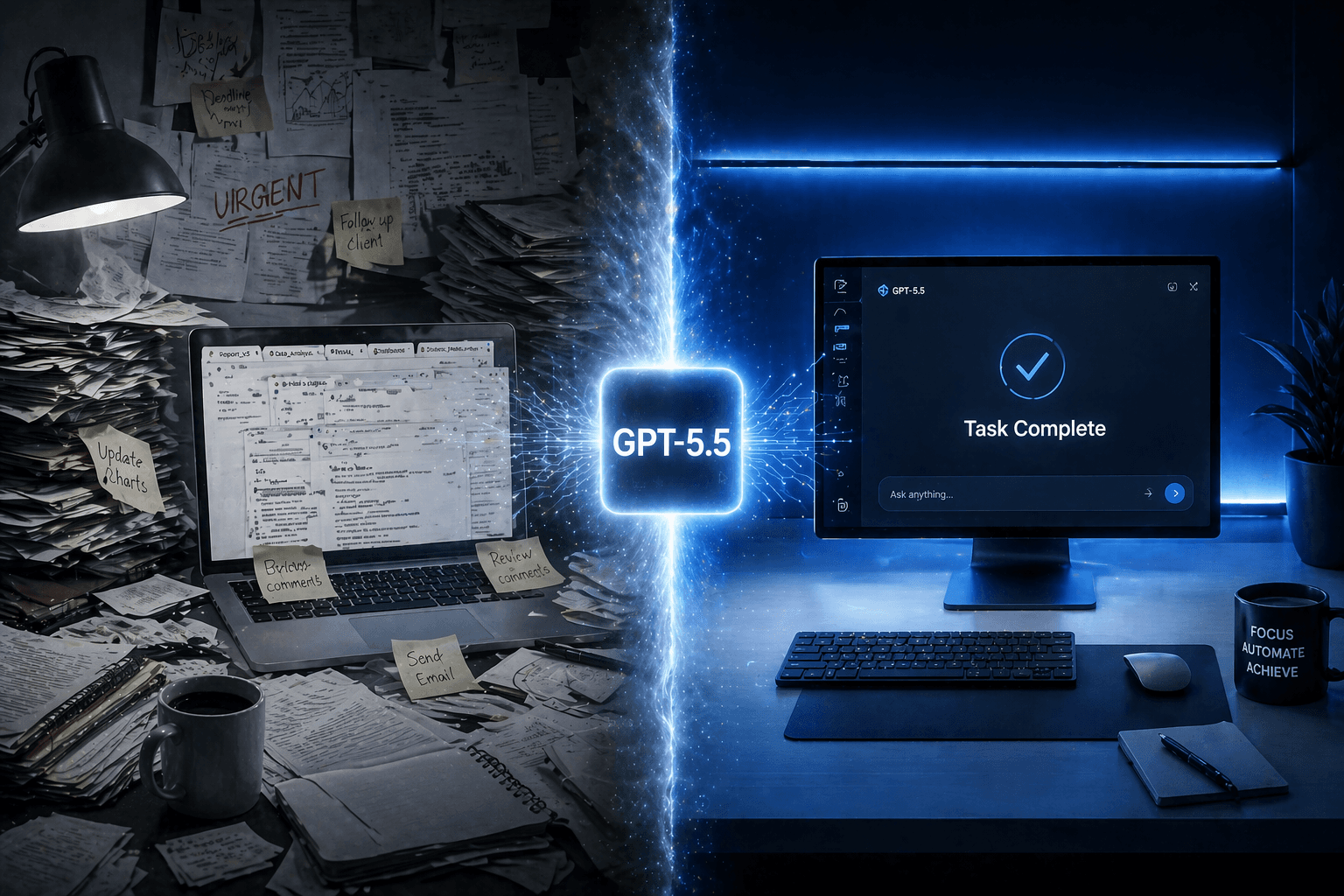
GPT-5.5 Is Here — and OpenAI Just Changed What "Doing Computer Work" Means
OpenAI dropped GPT-5.5 on April 23, 2026, just six weeks after GPT-5.4. The new model tackles messy, multi-step tasks without hand-holding — and it's only getting started.

GPT-5.5 Is Here — and OpenAI Just Changed What "Doing Computer Work" Means
Meta: OpenAI dropped GPT-5.5 on April 23, 2026, just six weeks after GPT-5.4. The new model tackles messy, multi-step tasks without hand-holding — and it's only getting started.
AI & Machine Learning · 4 min read
OpenAI didn't wait for a keynote or a product event. On Thursday, April 23, they quietly dropped GPT-5.5 to paid subscribers — and the update is a lot more interesting than another benchmark bump.
The company is calling it "a new class of intelligence for real work." OpenAI president Greg Brockman went further during a press briefing: the model, internally codenamed Spud, represents a genuine shift in how people will use computers — not just chatbots.
What's Actually New (Not Just Marketing)
The core improvement isn't raw intelligence. It's context understanding and autonomy.
Previous models needed step-by-step instructions to get through complex tasks. GPT-5.5 can receive a vague, multi-part problem, figure out what actually needs to happen, plan the approach, use tools, check its own work, and push through to a result — all without the user holding its hand.
OpenAI says early teams with access reported saving up to 10 hours of work per week. They used the model to gut-check vibe-coded software, review thousands of documents, and turn messy briefs into structured plans.
The biggest gains show up in four areas: agentic coding, computer use, knowledge work, and early scientific research.
The Number That Should Surprise You
GPT-5.5 is smarter and faster — but here's the curious part: it uses fewer tokens to do harder tasks than GPT-5.4.
That means it's not just a more powerful engine. It's a more efficient one. OpenAI's own data shows the model handles complex tasks at the same difficulty level in significantly less processing time. For enterprise users running thousands of queries, this matters a lot.
There's a catch: the API price is 2x higher than GPT-5.4. OpenAI argues the token efficiency makes it a net positive for most workloads. Whether that math works out depends on what you're building.
Curious Facts Worth Knowing
- The release cadence is now absurd. GPT-5.5 dropped seven weeks after GPT-5.4, which itself arrived six weeks after GPT-5.3. OpenAI's chief scientist Jakub Pachocki said users should expect this pace to continue — and get faster.
- 900 million weekly active users. ChatGPT now has more than 900 million weekly active users and over 50 million subscribers, along with 9 million paying business users. For context, Instagram took over a decade to reach similar scale.
- GPT-5.5 Thinking lets you interrupt it mid-thought. While the model is reasoning, users can inject new instructions before the final answer is complete — a small feature with large implications for complex workflows.
- Codex got a significant upgrade too. The coding assistant can now interact with web apps, test flows, click through pages, capture screenshots, and iterate on what it sees — essentially acting as a browser-native agent.
- Personality presets are now a thing. ChatGPT now ships with refined tone modes: Default, Friendly, Efficient, Professional, Candid, and Quirky. Two more (Cynical and Nerdy) are hidden in Personalization settings.
The "Super App" Angle
Brockman used Thursday's briefing to revisit a concept he and Sam Altman have been circling for months: a super app — a single unified product combining ChatGPT, Codex, and an AI browser. Think of it as the Swiss Army knife version of OpenAI's stack, aimed squarely at enterprise customers.
The idea puts OpenAI in direct competition with Elon Musk's ambitions for X, and signals that the company's long-term bet isn't just better models — it's owning the entire workflow layer of how knowledge work gets done.
GPT-5.5 isn't the finish line. OpenAI is shipping models like software updates now, and the gap between "AI assistant" and "AI coworker" is closing faster than most people expected.
Tags: GPT-5.5, OpenAI, ChatGPT, AI models, Codex, agentic AI, large language models, 2026